
In Year 9 at Barker, all students are required to study certain disciplines considered to be essential for effective living in a modern society. The core subjects for Year 9 are English, Mathematics, Science, HSIE, Christian Studies and Personal Development, Health and Physical Education (PDHPE). In addition, students choose three elective subjects in Year 9.
Further information about the core subjects can be found below.
Contact
Director of Academic Performance: Philip Mundy
Email: [email protected]
An overview of Core Course Requirements for Year 9 students
Christian Studies
In Year 9 we take as our theme: “Being Human”. Students wrestle with ways in which Christianity may contribute to their understanding of what it means to be human. There is an exploration of what might be identified as the fundamental needs of humans, including consideration of the importance of community. Students are encouraged to reflect on their own beliefs and convictions about God, human relationships and the purpose in life.
There is also a study of ethics in which personal and relevant moral issues are examined. Students explore Biblical teaching about compassion for others and then creatively design a product to be used by people in need in the local community. Year 9 concludes with an exploration of rites of passage in life, including important rites in the Christian faith.
English
In Year 9 English, students engage with a rich and challenging range of literary, visual, spoken and multimodal texts that deepen their understanding of language, literature and the world around them. Through the study of texts from Australia and across the globe, including those reflecting the perspectives and experiences of Aboriginal and Torres Strait Islander Peoples, students explore how language and texts shape ideas, values, identities and relationships.
Mathematics
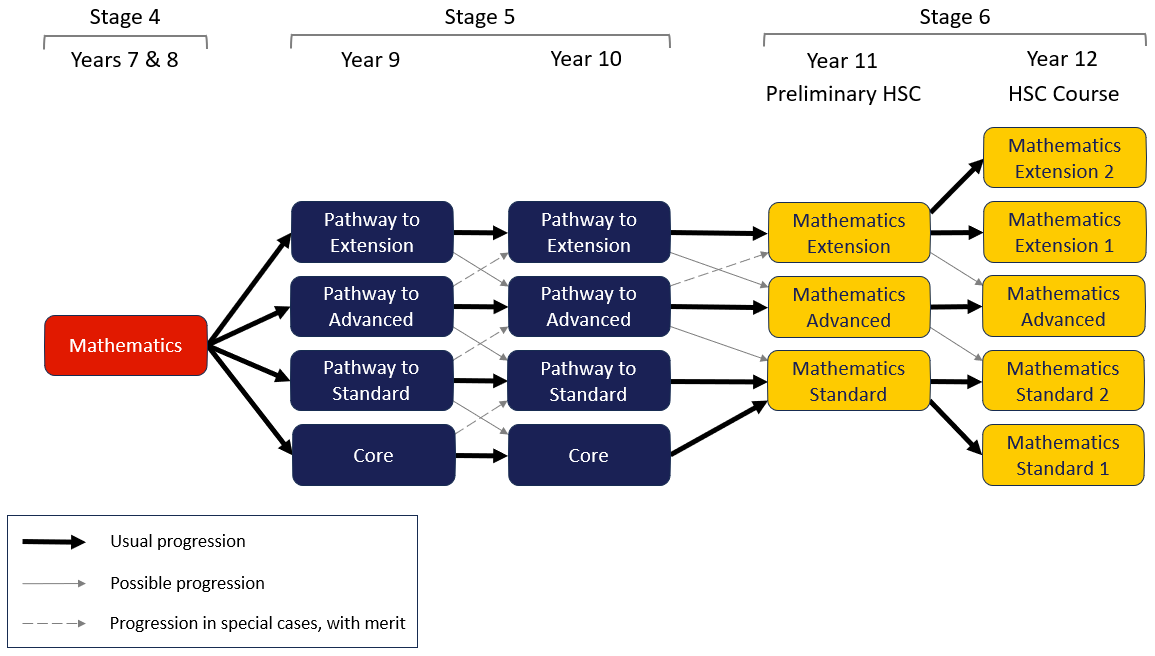
All students are required to study Mathematics over Years 9 and 10. There are four courses of study within Mathematics, called ‘Pathway to Extension’, ‘Pathway to Advanced’, ‘Pathway to Standard’ and ‘Core’. These courses are designed so that students will cover the mandatory content for Mathematics during these two years, as well as prepare them for their chosen Mathematics course of study during Years 11 and 12.
In October, after the Year 9 Readiness task (Assessment 2), the Mathematics Department will place each Year 8 student in the Year 9 course that best suits their mathematical ability and performance at that stage of their schooling, and enable them to have the highest chance of success in Year 9 and future years. A letter will be sent home in October communicating this placement, although class streaming within these levels will still be dependent on final Year 8 marks at the end of the year. Should parents/students wish to request a different course of Mathematics, they may contact Mr Hanlon (Head of Mathematics) a week after the final Semester 2 assessments in November to discuss a potential adjustment.
All Year 9 assessments will contain common content between adjacent pathways so that all students will know how they compare to students in pathways immediately above and below them. This will enable greater transparency over student’s suitability to alter their pathway.
Pathway to Extension: This course has been designed for the highly capable Mathematics student who shows a real aptitude for Mathematics and a significant ability to problem solve in unfamiliar contexts. As a guide, we expect around 25% of the cohort to be placed in this course. If it turns out that this course becomes too demanding, students can move to Pathway to Advanced.
The nature and format of the Pathway to Extension course enables students to learn the mathematical principles required for the study of any one of the three courses in Year 11 and 12, namely: Mathematics Standard, Mathematics Advanced or Mathematics Extension. Even highly capable students who do not apply themselves appropriately can find this course a significant challenge and a real struggle. Students and parents who wish to choose this level against the Mathematics Department’s recommendation should realise the vast majority of students who have done so have struggled to cope, lost confidence and generally performed poorly.
Pathway to Advanced: This course has been designed for the capable Mathematics student who shows a moderate aptitude for Mathematics and some ability to problem solve in unfamiliar contexts. As a guide, we expect around 40% of the cohort to be placed in this course. If it turns out that this course becomes too demanding, students can move to Pathway to Standard. If this course is not challenging enough, students may be able to move to Pathway to Extension.
The nature and format of the Pathway to Advanced course enables students to learn the mathematical principles required for the study of any one of the three courses in Year 11 and 12, namely: Mathematics Standard, Mathematics Advanced or Mathematics Extension, although an exceptional result would be required to access Mathematics Extension. Students and parents who wish to choose this level against the Mathematics Department’s recommendation should realise the vast majority of students who have done so have struggled to cope, lost confidence and generally performed poorly.
Pathway to Standard: This course is an appropriate level of study for those students who possess a reasonable level of mathematical intuition and ability. As a guide, we expect around 30% of the cohort to be placed in this course. If it turns out that this course becomes too demanding, students can move to the Core course. If this course is not challenging enough, students can move to Pathway to Advanced.
The nature and format of the Pathway to Standard course enables students to learn the basic mathematical principles required for the study of the Mathematics Standard course in Years 11 and 12. The Pathway to Standard course is not sufficient for the Year 11 Mathematics Extension or Advanced courses.
Core: This level is an appropriate level of study for those students who possess a basic standard of mathematical intuition and ability. As a guide, we expect around 5% of Barker of the cohort to be placed in this course.
The Core course allows students to complete the requirements for the study of Mathematics during Years 9 and 10. The nature and format of this level also enables students to learn the basic mathematical principles required for the study of the Mathematics Standard course in Years 11 and 12. This course is not sufficient for the Year 11 Mathematics Extension or Advanced courses.
The Pathway to Standard and Core courses can be good options for students to regain confidence. For example, a student who completed the equivalent of the Core course in Years 9 and 10 recently came second at Barker in the HSC Mathematics Standard course.
Science
The study of Science in Year 9 uses science inquiry to develop science knowledge and understanding through learning experiences set in relevant contexts. We have fully implemented the new NESA syllabus for Science and are pleased with the continuum of understanding that it develops across Years 7 – 10.
Students undertake practical experiences in most lessons where they develop skills and understanding of the process of Working Scientifically. Students will also develop knowledge and understanding about the nature, development, use and influence of science, as well as scientific concepts, ideas and principles.
The topics of study in Year 9 include:
-
Energy & its Uses
-
Disease, Immunity and Homeostasis
-
Materials- including minerals & their uses, chemical bonding, organic chemistry, polymer chemistry and biodegradability
-
Data Science – this is a new focus area in the syllabus that helps students understand the reliability of date, pseudoscience and an introduction to statistical analysis and evidence-based decision making.
Assessment of the course is through both formative and summative assessment including research, practical tests and an examination.
HSIE
In Stage 5 (Years 9 and 10), all students must also complete one year of Mandatory History and one year of Mandatory Geography. The table below indicates how this will take place, depending on the House group that your child is in. The School also offers History (Elective) and Geography (Elective) courses in addition to these mandatory courses. Students can choose to study these electives regardless of which year they are taking Mandatory History and Mandatory Geography.
Mandatory History
The Stage Five Mandatory History course helps provide an understanding of Australian history and our relationship with the rest of the world.
By exploring the origins of the slave trade and its effects on Africa, the new world and individuals, we establish an understanding of the movement of peoples and slavery over time.
The First and Second World Wars then become the focus as students consider Australia’s contributions and our role in the quest for global stability. In tandem with this is the challenge of Changing Rights and Freedoms in Australia and the United States. The course also explores international relations during the Cold War with a particular study of the Vietnam War which segues into analysis of Whitlam’s role in this era.
Students conduct individual historical research on a topic of their choice, and have a range of opportunities such as visiting speakers and excursions.
Students are encouraged to think about the important historical concepts of evidence, causation, and change over time as well as significant substantive concepts such as democracy, communism, and citizenship. In doing so, the course equips students for further study in History in the senior years and for life Beyond the Mint Gates.
Mandatory Geography
Studying the Stage 5 Mandatory Geography course, will develop an understanding of the interactions between people, places and environments across local, national and global scales. They will study topics such as sustainable biomes, environmental change and management, and human wellbeing, analysing spatial patterns, causes, impacts and responses. Case studies, including the Great Bear Rainforest and population change in China will enable students to explore environmental management, conservation strategies and the role of stakeholders in balancing ecological, economic and cultural needs.
Students will develop geographical inquiry skills by analysing data, interpreting maps and using spatial technologies to communicate informed conclusions. Key concepts such as sustainability, interconnection and change will underpin all learning in the course. Fieldwork will be undertaken within Sydney with a focus on environmental change and management, allowing students to collect and analyse primary data. This practical experience strengthens skills, deepens understanding, and promotes active engagement with real-world geographical issues.
PDHPE
Personal Development, Health and Physical Education aims to develop young people’s capacity to manage personal health, to achieve movement potential and to think critically about health and physical activity issues. This will enable them to be an advocate for health and physical activity. This subject will develop and challenge students through a holistic and integrated approach to health and associated issues. Students will participate in class work and physical activities to develop the knowledge, skills and attitudes necessary to understand, value and lead a healthy lifestyle. Strands covered include:
• Self and Relationships
• Movement Skill and Performance
• Individual and Community Health
• Lifelong Physical Activity